London Bookshops - Dr Holt

Question of the week: Could you talk about one of your favourite bookshops in London?

"Libraries and bookstores are captivating --- we enter with something in mind and find more than we may have imagined. I have two favourite bookstores, both architecturally atmospheric, both located smack in the midst of an engaging parade of interesting shops, and both ephemerally very London -- Daunt Books (located at 3 Marylebone High Street, London W1U 4QW) and Hatchard's (187 Piccadilly, London, W1J 9LE).

Enter Daunt Books Edwardian shop in Marylebone High Street, and before you've picked up a book you know you are in a splendid long room that draws you in and would hold you there as long as you'd like. What is remarkable is that books of all sorts -- fiction, poetry, politics, and travel are arranged by country -- what better way for us to browse and read about the places and cultures we are experiencing as we grapple with the experience of living in cosmopolitan London and with travels across the Continent and beyond. The website posts regular scheduled Events -- normally an author speaking for an evening hour or so about or in conversation with another recognizable figure. These amiable sessions require a ticket of £5 or so, a sum that includes a glass of wine. No obligation to purchase anything.

Hatchard's has been selling books in Piccadilly since 1797, and talking to customers about books that they like ever since. This congenial space in book-stuffed rooms over several levels is supported by unassumingly knowledgeable readers. Tables and shelves are filled with books they feel will bring readers enjoyment, and that other people are reading and talking about, as well. Here, too, authors' book-signings abound -- and extra copies of signed books remain afterwards for sale. A signed Book makes a very nicely considered gift. You, too, might like to browse there for a signed book to take home as a gift to your family or friends (or for yourself). If you are wondering what you might take home that is absolutely British and current and yet may be unavailable in the US, ask them about their VIPs -- Very Important Publications. "These titles are intriguing, exciting, exceptionally well written and, in our opinion, essential reading. We wholeheartedly recommend them, certain that they will provide readers with hours of pleasure.""
- Dr Holt

* Photos by pfig (Daunt books) and Swiv (Hatchard's), used under Creative Commons, with thanks.

London Bookshops - Kris

Question of the week: Could you talk about one of your favourite bookshops in London?

"Currently my favourite bookshop is Clerkenwell Tales. It has a number of things going for it: good selection of fiction (classic and modern, Anglophone and translated), and non-fiction (cooking and travel are key for me!), the owner and staff are very knowledgeable and friendly (and will make suggestions and order things they don't have), and it is close (so I don't have to carry any purchases very far). I can't think of a better combination of things to make a great local bookshop! And it's nice to support a real person, who really loves books, rather than a multi-national corporation - it just feels like the right thing to do.

Clerkenwell Tales is on Exmouth Market (just past the church). Their website is clerkenwell-tales.co.uk if you want to check them out online. Or, better yet, go in and have a chat!"
- Kris

* Photo by Frenkieb, used under Creative Commons.

London Bookshops - Miss Alice

Question of the week: Could you talk about one of your favourite bookshops in London?

"No collection of posts about London's bookshops could be complete without mention of Foyles - when Waterstone's moved into Piccadilly and took the title of London' largest bookshop (in terms of square feet, not titles stocked) Foyles answered by opening four branches to supplement their flagship Charing Cross Road shop, and took the title of Britain's overall UK Bookseller of the Year - not bad for an indie!

The original Charring Cross Road branch is well worth a visit, for it's expansive stock and expert staff, as well as the cafe. For a study in contrasts sit in the window of the cafe looking out across the road to Borders with its matching second-floor Starbucks."
- Miss Alice

* Photo by Bahi_P, used under Creative Commons, with thanks.

London Bookshops - Miss Alice

Question of the week: Could you talk about one of your favourite bookshops in London?

"Talking about just one favourite really is impossible here - a favourite *area* for bookshops in London? How about a favourite street for bookshops?

Tradition might say Charing Cross Road, but I am, instead, going to suggest Marchmont Street, running through the heart of Bloomsbury.

Starting at the Russell Square end, you have Skoob Books, offering a wealth of second-hand goodness tucked in behind the Bloomsbury Centre and open until eight of an evening for civilised browsing; then Gay's the Word, the UK's first(and, sadly, last surviving) gay and lesbian bookshop - well stocked and always welcoming; and then a little further down Judd Books, for more second-hand delights, this time with a more academic flavour, as befits the area.

I could list at least five more fantastic bookshops, all within a short walk of these three, but I shall restrain myself!"
- Miss Alice

* Photo by Highstone, used under Creative Commons.

London bookshops - Cornelius O’Boyle

Question of the week: Could you talk about one of your favourite bookshops in London?

"Long gone are the days when one could walk up Charing Cross Road and take one's pick of the many fascinating left-wing bookshops that lined this bibliophile's paradise. Since the fall of Communism in Eastern Europe, the funding that supported these impossibly cheap bookshops (funding which invariably came from the Communist Party of the USSR) has dried up and we are now left with drab outlets of ubiquitous chains such as Borders and Waterstones.

One bookstore, however, continues to wave the red flag of left-wing thinking, Bookmarks -- the Socialist Bookshop, appropriately located in Bloomsbury (1 Bloomsbury Street, WC1B 3QE), traditionally the heart of London's liberal intelligentsia. Much more than a front for the Socialist Workers Party of Great Britain, this shop maintains a wonderful stock of anti-establishment literature, ranging from flyers advertising direct action workshops to theoretical critiques of modern capitalism. To walk in the doors of this store is to realize that London still fosters modes of thinking that are radically different from those that dominate our modern consumerist society."
- Cornelius O’Boyle

* Photo by Clarissa~, used under Creative Commons, with thanks.

London sculpture - Miss Alice

Question of the week: The London Centre is hosting a conference on Eric Gill next week. Aside from Gill's work, do you have a favourite London sculpture or sculptor?

"Another impossible question - one of the things I love about my city is the profusion of incidental sculptures all over the place, and one of my colleagues has already written on Paolozzi. To pick just one though - maybe the Animals in War memorial, in Park Lane, to bookend a week's posts that started with the Cenotaph.

It's a multi-piece work, a huge curved, carved stone wall, and four bronze statues, unveiled in 2004 after a public collection to raise the funds. It's stranded in the middle of all the traffic, and and end of town I very rarely have reason to visit, but whenever I do, it never fails to move me."
- Miss Alice

* Photo by GaijinSeb, used under Creative Commons, with thanks.
London sculpture - Greg Kucich

Question of the week: The London Centre is hosting a conference on Eric Gill next week. Aside from Gill's work, do you have a favourite London sculpture or sculptor?

"My favourite sculpture in London is connected with my passion for all things related to the French Revolution! It is an eleven-foot statue of Napoleon, constructed by Canova, which now stands in the entryway to Apsley House, the family home of Wellington, who famously defeated Napoleon at the battle of Waterloo in 1815. Wellington could marvel at the sublimity of Napoleon on a daily basis and relish his own even more sublime triumph over Napoleon at Waterloo.

Apsley House, located in Hyde Park Corner, is fascinating in itself. It was designed by the famous architect Robert Adam and contains precious artwork as well as many historical details linked to the Napoleonic wars."
- Greg Kucich


* Photo by pixelthing, used under Creative Commons, with thanks.

London sculpture - Ric

Question of the week: The London Centre is hosting a conference on Eric Gill next week. Aside from Gill's work, do you have a favourite London sculpture or sculptor?

"In 1942 the area, which takes its name from Paternoster Row, centre of the London publishing trade, was devastated by aerial bombardment in The Blitz during World War II. It is now the location of the London Stock Exchange which relocated there from Threadneedle Street in 2004,
and of investment banks such as Goldman Sachs, Merrill Lynch and Nomura.

At the north end of the square is the bronze Shepherd and Sheep by Dame Elisabeth Frink. The statue was commissioned for the previous Paternoster Square complex in 1975 and was replaced on a new plinth following the redevelopment. The piece refers to both the religious connotations of Pater Noster - associated with neighbouring St. Paul's - and the site's rather more ancient use as a market for sheep and cattle."
- Ric

* Photo by Jonathan_W, used under Creative Commons, with thanks.

London sculpture - Cornelius O’Boyle

Question of the week: The London Centre is hosting a conference on Eric Gill next week. Aside from Gill's work, do you have a favourite London sculpture or sculptor?

"One of Britain’s least appreciated yet most influential artists of the 20th century, Sir Eduardo Paolozzi (1924-2005), did more than probably any other contemporary British sculptor to open up Britain to European trends in modernism and post-modernism. Born in Scotland, the son of Italian immigrants, Eduardo first studied art in Edinburgh and London. He then moved to Paris and worked with some of the world’s greatest 20th-century modernist sculptors, including Brancussi and Braque. He returned to London to set up his studio in Chelsea, from where he rapidly became one of London’s main conduits for surrealism, pop art, and German modernism.

What makes Paolozzi so fascinating is the sheer range of styles and materials he chose to work with. London is fortunate to showcase this magnificent facility, although Paolozzi’s works are not always displayed to greatest effect. How many people walking through the drab wind-swept piazza in front of Euston Station properly appreciate Paolozzi’s magnificent modernist “Piscator” sculpture? Or how many millions of passengers passing through Tottenham Court Road tube station stop to admire the amazing intricacy of his mosaic tiling? More popular with the tourists is Paolozzi’s giant post-modernist “Head of Invention” in front of the Design Museum at Butler’s Wharf, on the South Bank of the Thames.

One of his greatest works, however, has to be his instantly recognizable sculpture of Blake’s “Newton Inscribing the World” in the magnificent piazza of the British Library. But how many people really appreciate the irony of this piece? As a romantic, Blake had decried Newton’s attempt to expose nature’s true meaning through mathematics whereas here Paolozzi computerizes the famous image and sets it up in front of one of the world’s great institutions devoted to rationally comprehending man and nature. This is indeed an ironic apotheosis of Newton and the paradigm of (post-)modernity!"
- Cornelius O’Boyle

* Photos by R.P. Marks (Piscator) and Veeliam (both Newton images), used under Creative Commons, with thanks.

London sculpture - Dr Holt

Question of the week: The London Centre is hosting a conference on Eric Gill next week. Gill is well known for several works in public spaces, but is perhaps best known for his Prospero and Ariel on Broadcasting House. His work is currently being featured in the Royal Academy's Wild Thing exhibition and its public sculpture trail. Gill is one of hundreds of artists to have contributed to the richness of public statues around the city, so, aside from Gill's work, do you have a favourite London sculpture or sculptor?

"So many images, so hard to choose a single favourite, so I am choosing two:

The first is King George III, our near neighbour riding his handsome horse as if up Pall Mall East toward St James and the Palace. Students in the Trafalgar Square class know far more than I about this choice and placement of that statue there -- I simply note with affection this particular monarch who was so sensitively portrayed in the film 'The Madness of King George' (a film which I cannot recommend too highly, for a great many reasons).

The second is the Cenotaph in Whitehall -- indeed in the middle of Whitehall, so prominently placed that those who know what it is cannot pass without reflection about the nature and effects of nationhood and war and might and weakness, unto death. The term means 'empty tomb,' and we strangers to this sight may rightly wonder at it. But what can an empty tomb hold but all of death and at the same time, hope. I encourage you to stroll down to the Cenotaph while you are here and ponder it. Now is an excellent time to go, during days following Remembrance Sunday (yesterday) and leading up to Remembrance Day on the 11th, for a great many reasons." - Dr Holt


* Photos by C.K.H. (Gill/Prospero and Ariel),netNicholls (George III) and andwar (cenotaph) used under Creative Commons, with thanks.

Winter warmers

Question of the week: as the weather's getting colder, do you have a favourite Winter-warmer type recipe you'd like to share?

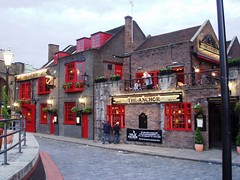
"Baked apples are a classic pudding this time of year, and for good reason. You'll need one cooking apple per person, plus some dark brown sugar, sultanas or mixed dried fruit, a smidge of butter, a sprinkle of ground cinnamon, an oven proof dish, and an oven preheated to 180c

The only tricky bit to the whole thing is coring your apples - it's easiest with a dedicated tool - like a tiny cookie-cutter on a mini bayonet - but if you don't have one of those around, no problem. Work carefully with a sharp knife, blade longer than the apple is high, to make four vertical cuts, forming a square column around the core. Carefully! Then push the column out, and you're good to go.

Now you just need to score a line around the circumference of the apple, and put them in your dish. Fill the core with alternate layers of your dried fruit and your dark brown sugar, tamping them down as you go, and ending with a little bit of butter and a final dab of sugar - the butter will melt down and make the fruit filling moist, but can be skipped if you've not got any to hand. Pop the whole thing in the oven for about half an hour.

The apples should be bursting at the seams with fluffy, light flesh, with the stuffing adding a rich sweetness. Serve with a light dusting of cinnamon, and either ice-cream of Greek yoghurt.

(For a quick fix, you can put a basic version of this together with an eating apple, no sugar or butter, and cook it in the microwave in about five minutes.)

* Photo by anjuli_ayer, used under Creative Commons, with thanks.
Winter warmers

Question of the week: as the weather's getting colder, do you have a favourite Winter-warmer type recipe you'd like to share?

"Bonfire Night tonight, so really the menu ought to be baked potatoes and bangers-in-a-bun, but if you need something to warm you up after watching a fireworks display, soup is rarely a bad idea. Soup recipes are always a bit vague, but here's an experiment that turned out very tasty indeed.

Red Pepper Soup.

I was working with roughly two red [bell] peppers and half a large onion person - for five I had ten peppers and three really substantial onions. Chop the onion fine, and soften really slowly in an almost obscene amount of butter until they're glistening and transparent. Add in the finely chopped [and seeded] peppers, and more butter if things are looking dry. Keep stirring them over the low heat, until they too soften and cook down. At a rough eyeball they reduced in volume somewhere between a half and a third. Add enough vegetable stock [or I guess maybe chicken or turkey stock, if you're carnivorous and have it to hand] to make it soupy but not to drown it [I added probably just less than half a pint.] simmer gently for a while longer, season to taste, and enjoy. I ran 2/3 of it through the food processor to get that really thick smooth texture, but it's hardly compulsory."
- Miss Alice

* Photo by Alan Cleaver/, used under Creative Commons.

Winter warmers

Question of the week: as the weather's getting colder, do you have a favourite Winter-warmer type recipe you'd like to share?

"I often get the urge to bake when it's cold and grey outside. This apple, honey and oat tray-bake seems pretty appropriate to the season.

You'll need:

110g butter
180g runny honey
1 medium egg
90g wholemeal flour
3/4 tsp of baking powder
3/4 teaspoon ground cinnamon
130g porridge oats
1 apple, cored but not pealed, and then either chopped finely or grated coarsely.

Preheat the oven to 190c, and grease your baking tray - a Swiss roll pan is ideal, but not essential. For added insurance, line with greaseproof paper. If you're using a non-stick tray that you care about, line with enough paper to form 'handles' on the short sides.

Either pop the butter in the heating over for a few minutes to mostly-melt it, or blast it in the microwave for 30 seconds or so.

In a large bowl, cream together the butter, honey, egg and vanilla until smooth.

Add the wholemeal flour, bicarbonate of soda and cinnamon and stir in.

Mix in the oats and the apple.

Drop into your baking tray, and press flat with the back of a spoon. If you don't have a baking tray with sides, leave a few cm clear at each edge and you'll probably be fine.

Bake for 10 to 12 minutes in preheated oven. Leave to rest for about five minutes before slicing up your tray-bake, and then leave to cool in the pan.

If you're using a non-stick tray that you care about, and remembered to line it with enough paper to form 'handles' use them to lift the whole thing out while it's still warm so you can cut and cool it out of the tray. "
- Miss Alice

* Photo by The Marmot, used under Creative Commons, with thanks.
Winter warmers

Question of the week: as the weather's getting colder, do you have a favourite Winter-warmer type recipe you'd like to share?

"Autumn may mean cobblers and pie to you, but to me it means crumbles - apple crumble, rhubarb crumble, blackberry crumble - it's all good.

Pre-heat your over to 180c, and plan for a very light main course!

The topping is very simple

Take 200g plain flour and 100g porridge oats (or 300g plain flour, if you don't have oats to hand), add to a bowl with 175g brown sugar, and mix.

Cut 200g butter into rough cubes, and give them a super-quick blast in the microwave to soften, but not melt them - maybe 10, 20 seconds?

Add to the flour, oat and sugar mixture, and rub in - pinch the mixture between your finger tips, rubbing your fingers together to mix the butter into the dry ingredients. When main you're done, your mixture will look like breadcrumbs.

For the filling, you want some kind of fruit - roughly 500g of it, that you peel, core, chop, or - if you're using berries - just pour straight into an oven-proof bowl. You want the end result to cook down some, so eating apples and pears work better than cooking pears. Mix in any spices that sound good to you, and maybe a little sugar if you think it'll be too tart without.

It's a little late in the year for rhubarb, unless you buy it tinned, but rhubarb is good with ginger, as are pears. Apples and cinnamon are natural partners, as are apples and blackberry, or apple and blueberry. Plums are great with a couple of cloves and a splash of port or red wine.

So, you now have a bowl of breadcrumb-like topping, and an oven proof dish filled about half way up with fruit. Just shake your topping over the fruit, using the back of a spoon to spread it around more or less evenly, and press it down gently.

Pop in the oven for 40 - 50 minutes, until the top is starting to brown, and the fruit is bubbling up around the edges.

Traditionally, crumble is served with custard, but it's also good plain, with ice cream, or with a scoop of Greek yoghurt."
- Miss Alice

* Photo by Amanda Rudkin, used under Creative Commons, with thanks.

Winter warmers - Miss Alice

Question of the week: as the weather's getting colder, do you have a favourite Winter-warmer type recipe you'd like to share?

"There's just something about stew that suits this time of year, although as with so many traditional-type foods, it's less a recipe than a rough guide. The photo I'm using here comes from a set uploaded by PodChef, author of the Gastrocast Blog, which takes you step-by-step through a delicious looking Scottish beef stew with potato cakes.

Being vegetarian, I use quorn chunks in pace of the meat, and more often than not go for a chicken-esque stew, with herby dumplings, which follows a basically similar process:

Take a couple of onions, chop, and put them to soften in a little oil.

Roughly chop a leek or two, and stick that in, along with a bag of quorn pieces, and a shake of either dried lentils or rolled oats (the lentils will add a little protein, but either does the job of helping thicken the stew.)

Stir in a good shake of dried herbs to your tastes - thyme and rosemary is a classic combo.

While they're slowly colouring up, prep and chop an assortment of root veg - potatoes, carrots, swede, turnips - whatever you fancy. If you're using chicken, you'll want to make sure the meat is properly cooked at this stage, but with quorn, it'll be done in the time it takes to prep the veg.

Pop the chopped root veg into the pot, and give them a quick stir about. Then pour over stock (stock cubes are fine, with or without a teaspoon of Marmite) and, if you fancy it, some beer, wine, or cider, to fill the pan up to about three quarters.

Bring to a slow boil while you make your dumplings: mix together 50g of self-raising flour, 25g of veggie suet, herbs to match whatever you used earlier, and just enough liquid to turn into a dough. (Particularly delicious with fresh chopped rosemary and cider as the liquid) If you're making a big pot of stew, scale the mix up accordingly - just keep that 2:1 ratio.

Roll the dough into dumplings, remembering that they will rise, so the uncooked one should fit easily into the palm of your hand. Drop into the stew, cover, and simmer for about half an hour.

If you wish, come back at about the 20 minute mark to add frozen peas and/or sweetcorn, and then again at the 30 minute mark to round up a sacrificial dumpling to cut up to check that they've cooked through.

Tuck in, and enjoy.

Any left overs will re-heat in the microwave, and probably taste even better than the fresh version. If you're re-heating on the hob, you might need to add a little more water or stock, and make sure everything's properly heated through. "- Miss Alice

* Photo by PodChef, used under Creative Commons, with thanks.
London's less-than-lovely history - Kris

Question of the week: With Halloween on the horizon, is there a particular episode from London's history that gives you the shivers?

"Possibly the most bloody and haunted place in London is the Tower of London. Since it was built in the 11th century it has the home of kings and criminals. William the Conqueror started building it in 1080, and was his London home. Castles were multi-use buildings, though, and the first documented prisoner held in the Tower arrived in 1100.

The tower was always a place of public execution, even (possibly especially) for the royal family. During the Wars of the Roses, Henry IV died there, as did his nephews, the 'Princes in the Tower'. Other well-known deaths at the Tower include Sir Thomas More and the two of Henry VIII's wives that were executed (Anne Boleyn and Catherine Howard). Lady Jane Gray, who was Queen for nine days, and Mary, Queen of Scots were other victims of the executioner's blade. The tower continued to be a place of torture and execution until it held its last prisoners during the Second World War. A number of German spies were executed there, ending in 1941, and Hitler's Deputy Führer, Rudolf Hess, was held there until the end of the War.

There have been many ghost sightings at the tower, including Arbella Stuart, cousin of King James I, and a phantom bear!

If you want to learn more about the Tower of London, and its horrible past, check out their website."
- Kris

~~~~~~~~~~

Want to read more? Related books in the LUP Library include:


Tower of London, the : 900 years of English history by Kenneth J. Mears

Building of London : From the conquest to the great fire, by John Schofield
and many of the guidebooks in the London Focus collection.

* Photo by Miss Alice, used under Creative Commons.

London's less-than-lovely history - Ric

Question of the week: With Halloween on the horizon, is there a particular episode from London's history that gives you the shivers?

"If you have an interest in the history of Catholicism and Protestantism in London, especially since the sixteenth century, then you should visit a place called Tyburn. All that remains of this terrible place is a marking on a pedestrian island in the middle of Marble Arch junction, immediately north of Hyde Park. It was the location, for many years, of a famous set of gallows (named 'Tyburn Tree') used for hanging religious non-conformists, including many Roman Catholics, as well as forms of criminal activity.

If you cannot find the mark on the road itself, why not visit the Covent and Shrine of the Tyburn Martyrs across the road from Hyde Park? For more information, and directions, see their website. ( A sister is available for guided tours of the Shrine daily at 10.30am,3.30pm & 5.30pm daily. HOLY MASS : Sundays, weekdays and Holydays: 7.30am. All are welcome)

Finally, for those interested in the history of religious persecution in London our chaplain, Fr John Dickson and I will be conducting a dusk tour of some sites relating to this on Wednesday, 9th of December. The walk will begin at the London Centre and end at K-M. Time to be announced!"

- Ric

~~~~~~~~~~

Want to read more? Related books in the LUP Library include:

Hanging in judgement : Religion and the death penalty in England from the Bloody Code to abolition by Harry Potter
and for Tyburn's later use as the most famous location for the execution of highwaymen,
1700 : Scenes from London life, by Maureen Waller.
as well as a vivid fictional portrayal in the film Plunkett & Macleane

* Photo by Lawrence OP, used under Creative Commons, with thanks.
London's less-than-lovely history

Question of the week: With Halloween on the horizon, is there a particular episode from London's history that gives you the shivers?

"Another obvious entry in the annals of horrible history has to be Jack the Ripper, who set off a wave of prurient panic in the Victorian newspapers in 1888, while getting away with the bloody murder of at least five, and maybe as many as eleven, prostitutes in London's East End before melting back into the shadows. Contemporary conspiracy theories ranged from unhinged surgeons to the Prince of Wales' son, Prince Albert Victor!

There are hundreds of books and websites exploring the murders and the world around them, not to mention inspiring novels, movies, and a brace of competing walking tours. (Personally, I like London Walk's version.)"
- Miss Alice

Want to read more? Related books in the LUP Library include:

East end chronicles, by Ed Glinert, London's underworld : Three centuries of vice and crime, by Fergus Linnane, and Victorian underworld, by Donald Thomas.

* Photo by I'veBeenThere!, used under Creative Commons, with thanks.
London's less-than-lovely history - Miss Alice

Question of the week: With Halloween on the horizon, is there a particular episode from London's history that gives you the shivers?

"If you're looking for Halloween horrors, Bethlem Insane Asylum during the 16th and 17th centuries has to make the list. Its reputation for cruelty, callousness, and corruption followed the hospital from it's original home, now buried under Liverpool Street Station, to it's next incarnation in Moorfields. The word 'Bedlam', meaning noise and chaos, is coined from its name.

The glamour and elegance of late seventeenth and eighteenth century fashions take on a rather different cast when you remember that many of those who could afford it would pay a penny to peer at the incurable insane in their cells, even poking them with sticks if they were insufficiently entertaining.

Thomas Tryon complained in 1695 about the public being admitted on holy-days:

"It is a very undecent, inhuman thing to make... a show... by exposing them, and naked too perhaps of either sexes, to the idle curiosity of every vain boy, petulant wench, or drunken companion, going along from one apartment to the other"


In 1815 the hospital moved again, and, as attitudes to insanity changed became a less hellish place. Nowadays is a respected psychiatric hospital on yet another site in south London, but those horror stories about patients being chained up, beaten, starved, and neglected, and then treated as a freak-show linger on in popular memory. "
- Miss Alice

Want to read more? Related books in the LUP Library include:

Mind-Forg'd Manacles : A history of madness in England from the restoration to the regency, by Roy Porter
and
Most Solitary of Afflictions: Madness and Society in Britain, 1700-1900 by Andrew Scull.

* Image: Hogarth's Rake's Progress #8

Break week


Back soon...

"Our students are on break this coming week, and so is the blog. We'll be back next Monday. Wishing our students a great break and safe journeys."


* Photo by jsgrites, used under Creative Commons.